Trainee Intubation Performance and Suction Choreography Using an Opaque Cocoa Hematemesis Simulant Versus Translucent Dye-Only Fluid: A Randomized Crossover Manikin Study
Article Sidebar
Main Article Content
Abstract
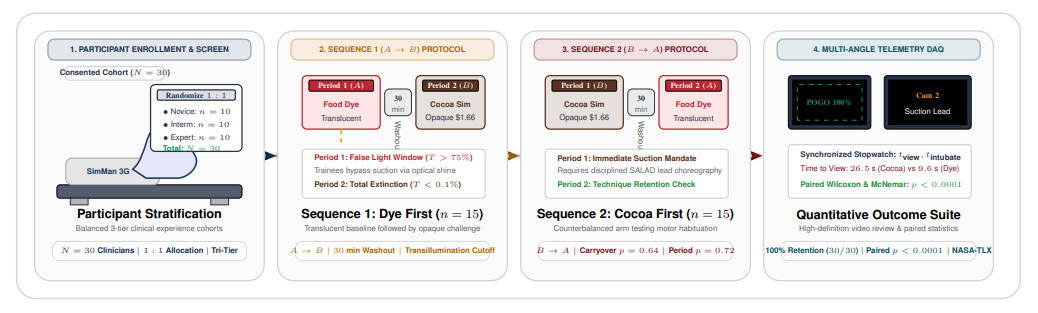
Acute massive gastrointestinal hemorrhage and pulmonary aspiration represent lifethreatening airway emergencies that frequently precipitate catastrophic intubation failure and hypoxic arrest. While simulation training in Suction-Assisted Laryngoscopy and Airway Decontamination (SALAD) is widely advocated to build procedural competence, the educational validity of simulation biofluids remains poorly characterized. Conventional simulation blood relies upon translucent culinary food dyes, creating an unrealistic transillumination artifact under video laryngoscope (VL) light-emitting diode (LED) illumination that permits trainees to visualize glottic landmarks through fluid layers that would be completely impenetrable in true human hematemesis. In this prospective, randomized crossover trial, thirty emergency medicine and anesthesiology trainees performed tracheal intubation on an airway manikin actively contaminated with either a translucent dye-only simulant or an opaque, low-cost cocoa-opacified hematemesis suspension (20 g/L unsweetened cocoa powder with sugar-free raspberry mix, $1.66/L). Primary outcomes were first-pass intubation success, time to definitive tracheal intubation, time to initial glottic visualization, and quantitative suction choreography metrics (suction lead time, suction catheter positioning latency, and intentional esophageal suction locking). When managing the translucent dye-only fluid, trainees achieved a 93.3% (28/30) first-pass intubation success rate, with a median intubation time of 32.4 seconds (interquartile range [IQR] 26.8–38.5) and a median glottic acquisition time of 9.6 seconds (IQR 7.2–12.8). However, when challenged with the opaque cocoa simulant, first-pass success collapsed to 56.7% (17/30; absolute difference −36.6%, 95% CI −54.2% to −19.0%, paired McNemar p = 0.0026), total intubation time doubled to 64.8 seconds (IQR 48.2–84.5; Wilcoxon signed-rank p < 0.0001), and time to glottic view escalated to 26.5 seconds (IQR 18.4–38.2; p < 0.0001). Under translucent contamination, trainees frequently bypassed proactive suctioning entirely (suction lead time < 2.0 seconds in 63.3% of trials), relying upon transillumination through pooled liquid to guide stylet insertion. In contrast, the opaque cocoa suspension completely obstructed camera visualization (Percentage of Glottic Opening score 0% prior to suctioning), compelling trainees to execute structured suction choreography, clear the pharyngeal pool, and anchor the rigid suction catheter in the upper esophagus. These empirical findings validate the optical opacity hypothesis, demonstrating that translucent dye-based simulants foster artificial complacency and uncoordinated suction habits. Adopting low-cost cocoa-opacified biofluids restores critical physical fidelity, driving genuine mastery of contaminated airway management.