Modeling of Brand Visibility Under Agentic Search and Shopping Mediation Using Structured Marketplace Signal Data
Article Sidebar
Main Article Content
Abstract
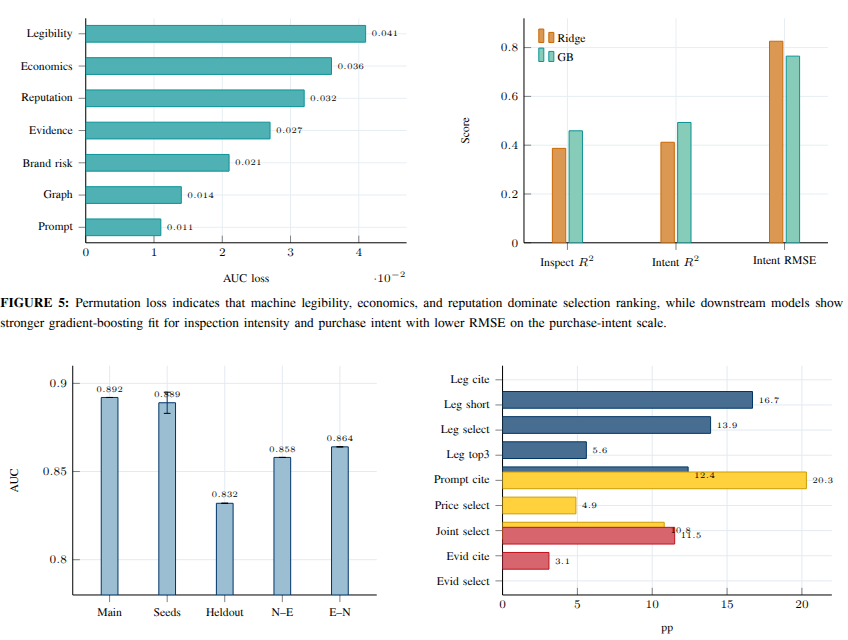
Digital commerce is increasingly shaped by systems that do not merely display ranked alternatives but interpret, summarize, cite, and select among competing products. This shift changes the empirical problem of brand visibility because a product can become influential through an intermediary recommendation even when a consumer never inspects the original page directly. This paper presents an empirical modeling study of brand visibility under agentic search and autonomous shopping mediation. A controlled dataset was constructed with 72,000 candidate-level observations generated from 1,200 shopping intents, ten competing product alternatives per intent, three AI-mediated interface conditions, and two prompt frames. The study measures visibility through citation in generated answers, inclusion in comparison shortlists, autonomous selection, post-selection inspection, and purchase-intent response. Product alternatives are represented with conventional marketplace signals, structured content signals, source evidence variables, product-affinity graph measures, and brand familiarity indicators. Logistic regression, gradient boosting, random forests, calibrated classification, grouped ranking evaluation, ridge regression, and counterfactual simulations are used to estimate how structured marketplace information relates to mediated brand exposure. The results show that schema density, specification completeness, semantic match, review volume, relative price, and evidence density jointly predict agent-mediated visibility. The best selection classifier achieved a ROC-AUC of 0.892 and an average precision of 0.444 on intent-grouped test data, while the best ranking model placed the selected product in the top three positions in 82.3\% of held-out tasks. Counterfactual simulations indicate that improving low-legibility product pages from the 30th to the 70th percentile raises predicted top-three visibility by 12.4 percentage points under otherwise comparable conditions.